What Is a.ovpn File and How Do You Open It?
Learn what a.ovpn file does, how to import it into OpenVPN Connect, and how to use it safely.
A.ovpn file is a configuration profile used by OpenVPN software to connect to a VPN server. To open and use one, install a compatible app such as OpenVPN Connect, import the profile, and provide any requested credentials. The file does not necessarily include a VPN subscription or the username and password required to sign in.
Compare ways to open and use an .ovpn file
| Option | What you need | How it works | Best for | Main consideration |
|---|---|---|---|---|
| OpenVPN Connect | OpenVPN Connect app | Import the file, then connect | Most users | Requires a valid profile |
| OpenVPN GUI | OpenVPN software for Windows | Add the file and connect from the app | Windows users | Setup varies by version |
| NetworkManager | Linux desktop with OpenVPN support | Import the profile in network settings | Linux desktop users | May need an OpenVPN plug-in |
| OpenVPN command line | OpenVPN installed | Run OpenVPN with the file | Advanced users | Uses terminal commands |
| Provider’s VPN app | App from your VPN provider | Sign in and select a server | Users who want guided setup | May not import .ovpn files |
| Text editor | Any plain-text editor | View or inspect the configuration | Checking file contents | Does not establish a VPN connection |
Compiled November 2026; check the provider's site for current details.
| VPN | Obfuscation | From / month | Plan | Free plan | Refund | Alipay | UnionPay | Crypto | Website opens in China | Trustpilot | |
|---|---|---|---|---|---|---|---|---|---|---|---|
 ZoogVPN | Turn on manually Shadow | $2.49/mo | 27 months: $59.99 | Yes | 7 days | ✓ | ✓ | ✓ | ✓ | Official site blocked; our special link opens (4.4 s) | 4.2/5 (195 reviews) |
 NordVPN | Turn on manually Obfuscated Servers / NordWhisper | $3.49/mo | 27 months: $94.23 | No | 30 days | ? | ✗ | ✓ | ✓ | ✗ Blocked | 4.2/5 (51,628 reviews) |
 ExpressVPN | ✓ On by default all servers | $3.00/mo | 28 months: $84 | No | 30 days | ✗ | ✗ | ✓ | ✗ | ✗ Blocked | 4.4/5 (29,706 reviews) |
 Surfshark | ✓ On by default Camouflage, with OpenVPN | See site | See site | No | 30 days | ✗ | ✗ | ✗ | ✓ | ✗ Blocked | 4.3/5 (31,823 reviews) |
 Proton VPN | Turn on manually Stealth, free plan too | $2.99/mo | 12 months: $35.88 | Yes | 30 days | ✗ | ✗ | ✗ | ✓ | ✗ Blocked | 2.1/5 (1,040 reviews) |
 Astrill VPN | Turn on manually StealthVPN / OpenWeb | $12.50/mo | 24 months: $300 | No | See site | ✗ | ✗ | ✗ | ✓ | ✗ Blocked | 1.3/5 (110 reviews) |
 Private Internet Access | Turn on manually Shadowsocks, OpenVPN only | $2.03/mo | 40 months: $81.2 | No | 30 days | ✗ | ✗ | ✗ | ✗ | ✗ Blocked | 4.2/5 (11,033 reviews) |
 CyberGhost | Turn on manually selected servers | $2.19/mo | 28 months: $61.32 | No | 45 days | ✗ | ✗ | ✗ | ✓ | ✗ Blocked | 4.0/5 (24,178 reviews) |
 PureVPN | Turn on manually switch to OpenVPN | $1.69/mo | 60 months: $101.55 | No | 31 days | ? | ? | ✗ | ✓ | ✗ Blocked | 4.4/5 (17,994 reviews) |
 AdGuard VPN | ✓ On by default TrustTunnel | $2.99/mo | 24 months: $71.76 | Yes | 30 days | ✓ | ✗ | ✓ | ✓ | Official site blocked; our special link opens (3.7 s) | 4.3/5 (290 reviews) |
 Mullvad | Turn on manually QUIC / Shadowsocks / LWO | $5.61/mo | €5/mo | No | 14 days | ✗ | ✗ | ✗ | ✓ | ✗ Blocked | 3.2/5 (192 reviews) |
 Windscribe | Turn on manually Stealth / WStunnel | $5.75/mo | 12 months: $69 | Yes | See site | ✗ | ✗ | ✗ | ✓ | ✗ Blocked | 4.7/5 (13,355 reviews) |
 StrongVPN | Turn on manually Scramble, OpenVPN TCP | See site | See site | No | 30 days | ✓ | ✗ | ✗ | ✗ | ✗ Blocked | 4.4/5 (2,695 reviews) |
 LightXtreme 闪连 | Not listed | $7.08/mo | 12 months: $84.99 | Yes | 30 days | ✓ | ✓ | ✓ | ✓ | ✓ Yes (3.5 s) | No page |
Prices checked 2026-11-10 on each vendor's pricing page (cheapest long plan, USD). Check the vendor's checkout for the final price.
Obfuscation checked 2026-11-14 on each vendor's site and help center: "on by default" = nothing to set; "turn on manually" = switch protocol or mode in settings; "not listed" = the vendor describes no obfuscation.
Payment methods checked 2026-11-10 on each vendor's payment pages: all 14 take cards and PayPal; ✗ = not listed, ? = the vendor's own pages disagree.
China access: whether the official website opens from mainland China networks (tests the website only, not the VPN connection). Last checked 2026-11-18 01:02 Beijing time.
Trustpilot score and review count checked 2026-11-10.
What is a.ovpn file?
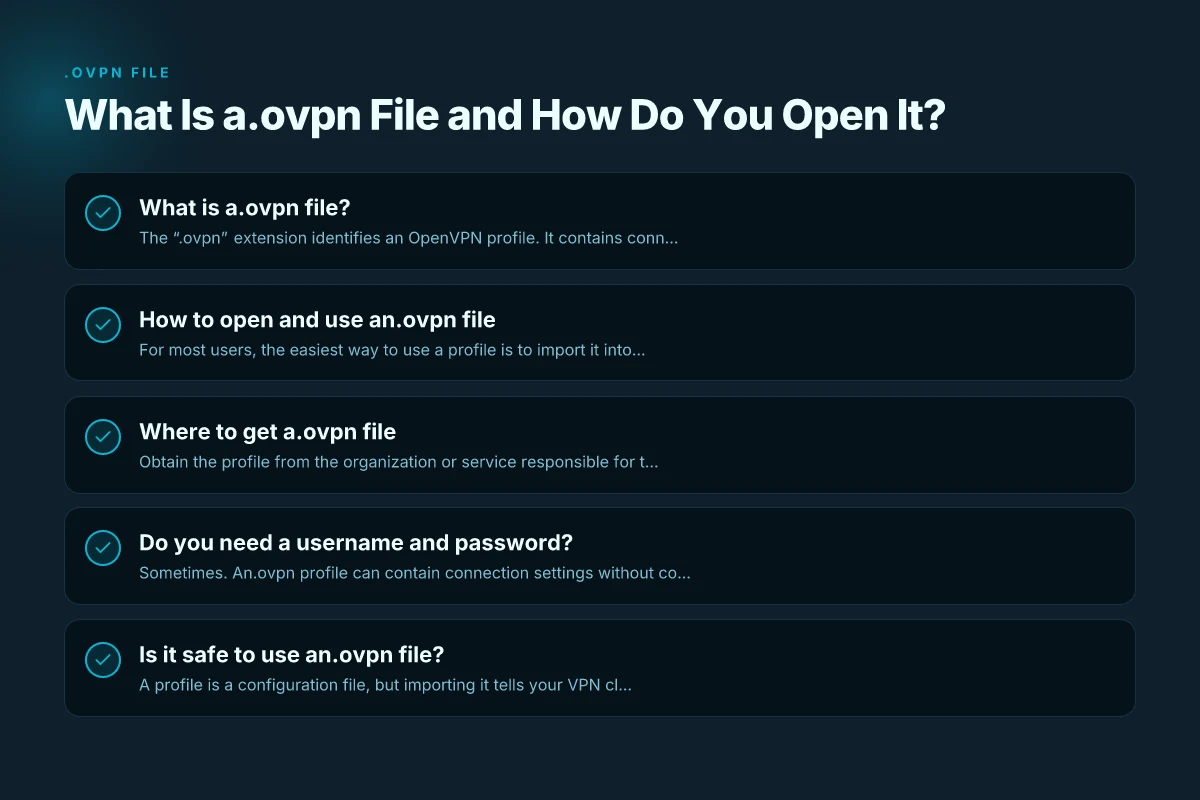
The “.ovpn” extension identifies an OpenVPN profile. It contains connection settings that tell an OpenVPN client how to reach a particular VPN server and establish a connection. Depending on how the profile was created, it may also include certificates or other connection information.
OpenVPN Connect describes these configuration files as profiles. A profile may be supplied by a VPN service, your workplace or school, a network administrator, or someone who runs their own OpenVPN server.
An.ovpn file is not, by itself, a VPN service. It is configuration data for connecting to a server. You need access to a working server, and the server may require an account or other authentication.
How to open and use an.ovpn file
For most users, the easiest way to use a profile is to import it into an OpenVPN client. OpenVPN Connect is one option. Other compatible clients may also support.ovpn profiles. Best VPN Extension for Edge: How to Choose the Right One
A typical process looks like this:
- Get the profile from your VPN provider or administrator.
- Install OpenVPN Connect or another compatible OpenVPN client.
- Open the app and choose its option to import or add a profile.
- Select the.ovpn file, or follow the app’s instructions for importing it.
- Enter a username, password, or other requested credentials.
- Connect, then check the app’s status to confirm whether the connection succeeded.
The exact menus differ across operating systems and app versions. Some providers offer a download page where you choose a server location and download its profile. Other administrators send the file directly or provide instructions for adding it to a device.
| Item | What it does |
|---|---|
| .ovpn file | Supplies OpenVPN connection settings for a server |
| OpenVPN client | Reads the profile and attempts to create the VPN connection |
| Credentials | Verify that you are allowed to use the VPN, when authentication is required |
| VPN server | Receives the connection and provides access according to its configuration |
If the client reports an error, confirm that you selected the correct profile and that your credentials are current. Your provider or administrator can tell you whether you need additional files or settings.
Where to get a.ovpn file
Obtain the profile from the organization or service responsible for the VPN you intend to use. A VPN provider may let you select a server and download its configuration. For a work or school VPN, contact the network administrator. If you operate your own OpenVPN server, create or obtain a client profile using the server’s configuration and setup instructions. VPN FortiClient: What It Is, How to Connect, and What to Know
Do not assume that a random profile found online will connect to a safe or reliable VPN. A working file may point to a server you do not control, and you may not know who operates it or what information they collect.
Before importing a file, check:
- Who provided it and whether that source is legitimate.
- Which server or service the profile is meant to connect to.
- Whether the provider requires separate login details.
- Whether the profile is current and intended for your device or account.
Compare sources for an .ovpn file
| Source | How you get the file | Account usually needed | Trust level | Check before using |
|---|---|---|---|---|
| VPN provider | Download from its website or app | Yes | High if it is your provider | Confirm the site is genuine |
| Workplace IT team | Request the profile from IT | Usually | High if received through official channels | Follow workplace instructions |
| School or organization | Download from its official portal | Often | High if the portal is genuine | Confirm the profile is current |
| VPN administrator | Receive it directly from the administrator | Usually | Depends on the administrator | Verify the sender |
| Public download site | Download from a third-party page | No | Uncertain | Avoid profiles from unknown sources |
| Email attachment | Receive from a sender | Varies | Depends on the sender | Confirm it was expected and unaltered |
Compiled November 2026; check the provider's site for current details. VPN Extension Free Edge: How to Choose a Free VPN for Microsoft Edge
Do you need a username and password?
Sometimes. An.ovpn profile can contain connection settings without containing the credentials needed to log in. The OpenVPN app may prompt you for a username and password when you connect. Your provider or administrator should explain how to get these details and whether they are separate from your usual account password.
Some profiles use other authentication methods or include certain certificates within the profile. Requirements depend on the server’s setup, so there is no single credential rule for every.ovpn file. If you are unsure what the app is asking for, check the instructions from the source that supplied the profile rather than guessing.
Is it safe to use an.ovpn file?
A profile is a configuration file, but importing it tells your VPN client how to connect. Treat it with the same care you would give other network configuration files. Use profiles only from a source you trust, and avoid running or importing files from unknown websites, messages, or repositories without verifying them.
A profile also does not prove that a VPN service is trustworthy. It only provides connection instructions. Consider who runs the VPN server, what service you are using, and whether its privacy and security practices meet your needs. If the profile came from your employer, school, or a provider, ask that organization about any unfamiliar settings or connection warnings. Best Free VPN Extension for Edge: Top Picks and What to Know
Decide whether to use an .ovpn file
| Situation | Username and password | Safe to use? | Recommended action | Key point |
|---|---|---|---|---|
| Profile from your VPN provider | May be required | Usually, if authentic | Use the provider’s instructions | Credentials may be separate |
| Profile from your employer | Often required | If verified with IT | Ask IT how to connect | Use approved devices and settings |
| Profile from your school | May be required | If from the official portal | Follow school instructions | Access rules may apply |
| Profile from an unknown sender | Unknown | No | Do not import it | It may route traffic to an untrusted server |
| Profile from a public forum | Unknown | Not recommended | Get one from a trusted provider | The file alone does not prove legitimacy |
| Profile that requests unexpected credentials | Unclear | Pause and verify | Contact the provider or administrator | Do not reuse unrelated passwords |
Compiled November 2026; check the provider's site for current details.
Recommendation
If you need to connect to an OpenVPN server, get the.ovpn profile directly from the VPN provider or administrator, then import it into OpenVPN Connect or another compatible client. Confirm whether separate credentials are required, and avoid using profiles from sources you cannot verify.